The Birthplace of Sheridan: A Brief History of the Mandel Cabin

Before Sheridan rose to prominence as the economic and civic nucleus of northern Wyoming, a small, unofficial settlement named Mandel laid the foundation, both physically and administratively, for what would become one of the state’s most important frontier towns. Situated near the junction of Big and Little Goose Creeks, Mandel emerged in the early 1880s during a pivotal moment in the settlement of the Powder River Basin, only a few years after the U.S. Army’s defeat at the Battle of the Little Bighorn and the formal opening of northern Wyoming to homesteaders.
Mandel was never formally platted nor incorporated, but for a short and vital period, from its establishment as a post office in 1881 to its renaming in 1882, it served as the region’s earliest civic and commercial center. Founded by George Mandel, a European immigrant and one of the first to stake a claim in the area, the site included a rudimentary log structure that housed the first post office, store, polling place, and community meeting site.
Though Mandel as a name vanished from maps, it did not vanish from history. When John D. Loucks purchased the Mandel property in 1882, he repurposed the existing structures, renamed the post office after his former Civil War commander, General Philip H. Sheridan, and began planning what would become the town of Sheridan. In this way, Mandel was not a failed settlement but rather the embryonic stage of a town that would eventually thrive.
This chapter will examine the short-lived yet pivotal history of Mandel, Wyoming, tracing its timeline, principal figures, and the material culture of its log-built core, an outpost that quietly bridged the wilderness and the emergence of permanent settlement in northern Wyoming.
The Geographical and Political Context of 1880 Wyoming
By 1880, northeastern Wyoming was still very much in the throes of post–Indian War transition. The Great Sioux War of 1876–77, which included the Battle of the Little Bighorn (June 25, 1876), resulted in the forced removal of many Indigenous populations from the region. Military pressure, combined with treaties and allotment policies, cleared the way for white settlers to occupy lands previously considered perilous.
Although the lands around Big Goose and Little Goose Creeks had not been officially surveyed or opened for homesteading, settlers nonetheless began arriving and staking informal claims under squatter’s rights. This legal gray area enabled individuals to construct homes, plant crops, and operate businesses while anticipating future land patents under the Homestead Act of 1862 or Desert Land Act of 1877.
Pre-Arrival of George Mandel and the Establishment of Mandel Post Office (1873–1881)
Among the first to leave a documented mark on the landscape was J. Peter “Dutch Henry” Van Dover, a German immigrant and seasoned frontiersman who ventured into the “Little Goose Country” in the fall of 1873.
His presence in the region is detailed in the Empire Builders, by Ida McPherren, where he recounts building and residing in a log cabin situated at the confluence of the Goose Creeks, this location would become Mandel and, eventually, Sheridan settlement.
Van Dover asserted that this was the first cabin constructed at what is now Sheridan, built in spring 1878 with the help of a fellow trapper. The structure was simple, lacking a roof until the fall of that year, when it was covered with dirt to insulate it from the harsh northern Wyoming climate. Dutch Henry lived there with his Shoshone companion and the other trapper and his Native wife. Although he acknowledged that several other trapper huts and dugouts existed in the broader region, including near present-day Big Horn and Buffalo. Van Dover maintained that this cabin was the first erected on the exact site where Sheridan would later rise.
In spring 1879, Van Dover’s Shoshone partner returned to her tribe, and the cabin’s occupancy changed hands several times. According to his account, it was later inhabited sequentially by the White brothers, a man named Mandell, Dr. J.P. Rhoads (full name John Pulse Rhoads, has often been erroneously referred to in early newspapers as "Dr. Lloyd Rhodes." In reality, Rhoads was the correct individual and the son-in-law of J.M. Works; the confusion likely originated from typographical or reporting errors in the contemporary press.), and eventually, John D. Loucks. This gradual succession of residents reflects the transitional nature of early settlement on the frontier, where makeshift structures often passed from one pioneer to another as opportunity, hardship, or enterprise dictated.
It was around early 1880 that George Mandel, a settler with prior experience in southeastern Wyoming, arrived in the Goose Creek Valley. By most historical accounts, Mandel took possession of the very log cabin that Dutch Henry had originally constructed two years earlier. The dwelling, though primitive, became central to Mandel’s operations. He established a small general store, opened the Mandel post office in 1881, and used the building as a local meeting place and, at times, a polling station.
By October 1880, Mandel had improved upon this structure, hauled lumber from the Bighorn Mountains with oxen, and began operating a small store and trading post. Most importantly, Mandel submitted an application to the U.S. Post Office Department to establish a postal stop to serve the growing number of settlers and transients in the valley.
On March 2, 1881, the United States government officially recognized the Post Office of Mandel, Carbon County, Wyoming Territory, with George Mandel appointed as the first postmaster. The choice of name “Mandel” was likely a practical placeholder, but it was now inscribed in federal records. This Location served not only as a mail hub but also as a general store, social center, and geographic reference point for the surrounding ranchlands. Travelers heading between Fort Custer (Montana Territory) and Fort McKinney (near present-day Buffalo, Wyoming) often stopped to water horses and rest at Mandel.

Above: Map of Wyoming from 1883 with black square showing enlarged section where the town of Mandel in Johnson County was located. This map was published in the Hardesty's Historical and Geographical Encyclopedia from 1883.
Meanwhile, Dr. J.P. Rhoads, acquired a drug store from John D. Loucks in 1879 in Bedford, Iowa. Their paths would intersect again.
In early 1881, Mandel entered into a business partnership with Dr. Rhodes. The Mandel-Rhodes partnership expanded the store and increased the trading volume with nearby ranches. According to Dr. Rhodes’s later affidavit, by the summer of 1881, the buildings at the site consisted of at least three structures: the original log dwelling (believed to be Dutch Henry’s), a two-room house, and a stable or barn. None were built on titled land; all improvements rested on public domain.
Yet by late 1881, Rhodes was growing concerned about the increasing influx of settlers. He would later describe this growth as chaotic and uncontrolled, noting in 1925 that the buildings at Mandel had “no known ownership.”
In 1881 Loucks relocated to Montana, and around late 1881, early 1882, he wrote to Dr. Rhoads from Miles City, expressing interest in purchasing the Mandel store. This correspondence set into motion Loucks becoming the founder of Sheridan.
Henry Held's Recollections of Mandel and the Future Site of Sheridan

Another valuable firsthand account of Mandel and the Goose Creek Valley comes from Henry Held, a German-born blacksmith and early settler who arrived in northern Wyoming in March 1882, only weeks before John D. Loucks acquired the Mandel property. Writing in 1925 for the Old Settlers' Club of Sheridan County, Held recalled traveling north from Camp Carlin with Frank Keeler, hauling blacksmith tools, iron, and horseshoes with the intention of establishing a shop in the new country.
After reaching Buffalo, Held crossed Piney Creek and continued toward the Goose Creek settlements. He first explored Big Horn, where a local merchant confidently predicted that Big Horn would become "the future city of Northern Wyoming." Held disagreed. He believed the settlement sat too close to the mountains and lacked the geographic advantages necessary for a major town. Continuing northward, he followed Big Goose Creek and climbed to a vantage point overlooking the confluence of Big and Little Goose Creeks. There he encountered what he later described as one of the most beautiful sights he had ever seen. Before him stretched a broad, level expanse where the two creeks joined, framed by the Bighorn Mountains to the west and extending toward the Wall Mountains to the east.
Held remembered that only a small cabin stood along Big Goose Creek at the time. Looking over the landscape, he became convinced that if a city were ever built in this region, it would rise at the forks of the creeks. "No matter in which direction I looked," he later wrote, "the country seemed to center here." His observations are particularly significant because they were recorded decades later by a man who witnessed the area immediately before Sheridan's formal establishment.
Riding down to the cabin, Held met George Mandel in person. He found Mandel operating from the humble settlement that served as the area's post office and trading center. According to Held, Mandel possessed only a sack of flour, part of a sack of sugar, and a cigar box that functioned as the post office. Mandel was then preparing to file desert land claims on two sections of land surrounding the settlement. Held advised him against the effort, believing the abundance of water and timber would make such claims difficult to secure. Nearby, he also encountered Harry Suthen, who soon filed a homestead claim on 160 acres that would later become important to the community's development. Suthen ultimately agreed to provide Held with forty acres for a prospective townsite, a transaction that further tied Held to the earliest development of the area.
Held also recalled meeting G.T. Beckton, for whom Beckton was later named, and noted that early mail service briefly traveled by way of Beckton before Sheridan established its own postal route. He further remembered Dudley Thurmond and his family arriving in the valley and acquiring land from Harry Suthen. These recollections offer a rare glimpse into the small network of pioneers who occupied the Goose Creek Valley during the final months of Mandel's existence.
According to Held, he soon arranged for lumber to be hauled from a sawmill in Banner and began constructing a blacksmith shop and a saloon. He later wrote that "we then had a town and called it Sheridan." Although this statement reflects the way Held remembered events more than four decades later, it demonstrates how rapidly the settlement evolved from a small frontier outpost into a recognizable community.
Interpreting Henry Held's Account
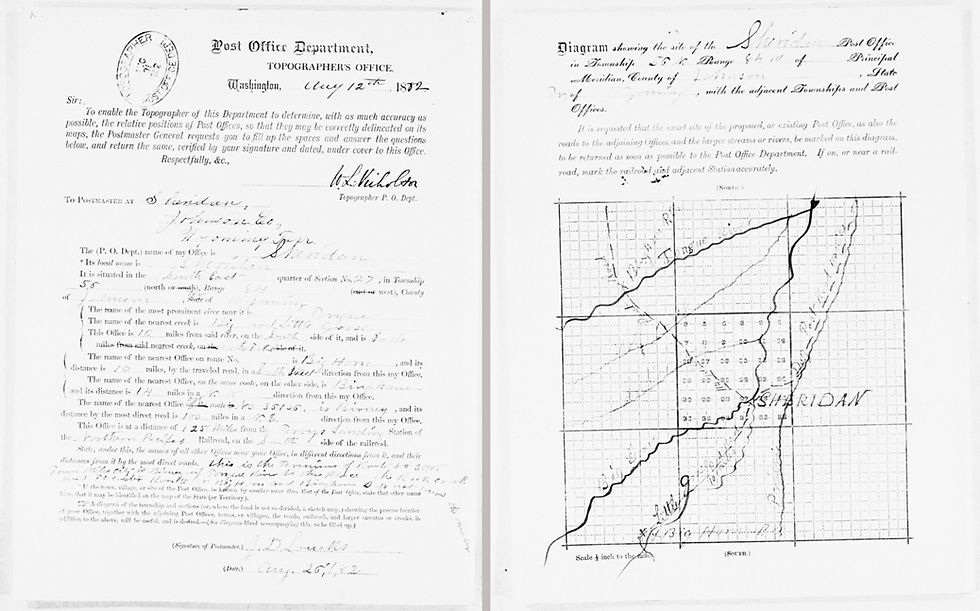
While Henry Held's reminiscence provides one of the most valuable firsthand descriptions of Mandel and the future Sheridan townsite, it must also be read with an awareness of its limitations. Held recorded his memories in December 1925, more than forty-three years after the events he described. As is common with pioneer recollections, some portions of his narrative appear to compress events that occurred over several months into a single sequence. For example, Held's account suggests that the settlement was already known as Sheridan shortly after his arrival in March 1882, whereas postal records demonstrate that the community was still officially known as Mandel at that time and was not renamed Sheridan until later that year.
Despite these chronological inconsistencies, Held's narrative remains historically significant. His account places him in the Goose Creek Valley during the final months of Mandel's existence, before John D. Loucks fully established Sheridan. Most importantly, Held recorded his immediate reaction upon viewing the broad, open ground at the junction of Big and Little Goose Creeks. He recalled thinking that if a city were ever built in this part of Wyoming, it would naturally rise at the forks of the creeks because the surrounding country seemed to converge there. This observation is strikingly similar to the later recollections of John D. Loucks, who described standing on nearby Court House Hill and envisioning a future city in the valley below.

Whether Held arrived before Loucks began implementing his plans for the settlement cannot be stated with complete certainty. What can be said is that Held's testimony demonstrates that more than one pioneer recognized the strategic advantages of the location. The convergence of the two creeks, the availability of water and timber, the broad expanse of level ground, and the natural transportation routes leading into the Bighorn Mountains made the site an obvious focal point for future development. In that sense, Held's recollections provide independent confirmation that the location chosen for Sheridan was not accidental but was widely viewed by early settlers as the most promising townsite in northern Wyoming.
Although the documentary record continues to identify John D. Loucks as the founder of Sheridan, Henry Held's account preserves an important perspective from another pioneer who witnessed the transformation from the tiny settlement of Mandel into the community that would become Sheridan. His memories offer a rare glimpse into the thought process of those who first looked upon the Goose Creek Valley and imagined a town where only a handful of cabins then stood.
By March 1882, Dr. Rhodes’ father-in-law, J.M. Works, took over as Postmaster, and by April 1882, both Mandel and Rhodes were ready to leave the settlement. Mandel had grown frustrated with the demands of operating the post office and store. He also feared being displaced once the area was formally surveyed, as his desert land claim had not yet been patented.

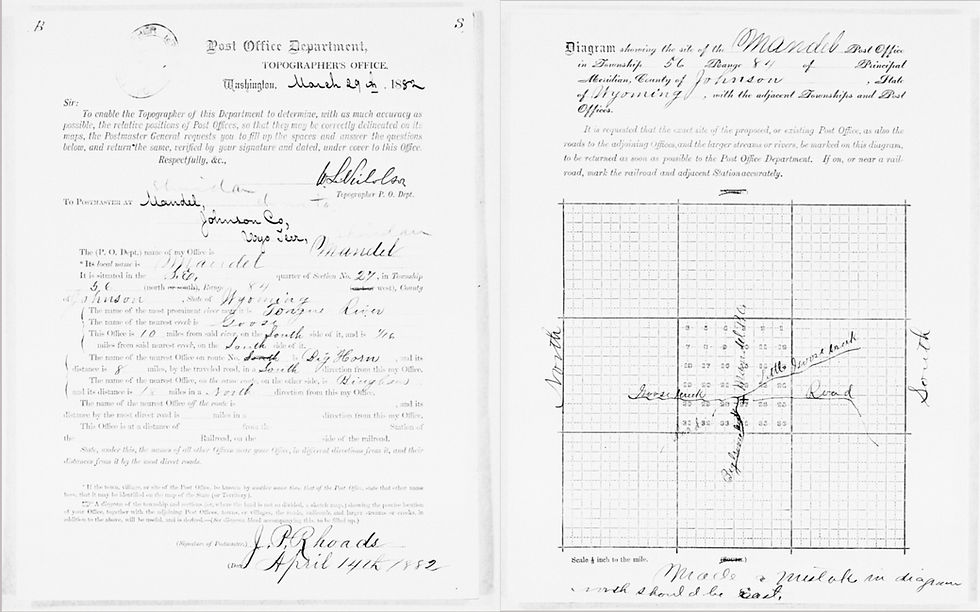
In April 1882, the entire property, post office, store, improvements, and squatter's rights were sold to John D. Loucks, a Union Civil War veteran and former Iowa merchant who had recently arrived in the area. The transaction reportedly amounted to $50. At the time of sale, Loucks took possession of the existing structures and assumed the role of postmaster.

By early 1883, the name "Mandel" disappeared from usage. Loucks successfully petitioned the Post Office Department to change the name of the post office from Mandel to Sheridan, in honor of General Philip H. Sheridan, under whom he had served during the war.
Though the precise date of the name change remains unclear in federal postal records, June 7, 1883, marks the transition from Mandel to Sheridan.
Although Mandel existed officially for just 17 months (Nov. 1880 – April 1882), its brief tenure provides critical evidence of:
The informality of early settlement patterns in northern Wyoming.
The importance of postal recognition as a town-building strategy on the frontier.
The ephemeral nature of many early western communities, particularly those formed before the arrival of railroads or formal land surveys.
The designation of a post office often served as the first step toward civic legitimacy in the American West. Mandel was no exception. In many ways, the shift from “Mandel” to “Sheridan” represents not just a name change, but a shift from frontier improvisation to municipal intent.
By September 1882, Clara (Works) Moeller opens first school in Sheridan in the building known as the Mandel Cabin. She taught approximately 17 students that term which did not finish in the cabin, by spring of 1883 the school was transferred to the new frame building where Sheridan’s Post office stands (2025). In the summer of 1883, Loucks tore down the cabin on Smith Street and rebuilt it with an expansion and upstairs living quarters on the corner of Loucks and Main.
In 1886, E.A. Whitney purchased Louck’s building and turned it into the National Bank of Sheridan (seen at Right).
In 1902 when the new bank building was built the original building was moved across the alley close to the Carnegie Library. After the building moved it became 31 West Loucks Street.


On May 11, 1914, the Sheridan chapter of the Daughters of the American Revolution unveiled a monument where the Mandel cabin originally sat. The marker is located near the corner of Smith and Brooks streets. In the speech that Loucks wrote for the DAR marker dedication, read by Mrs. W.M. Spear, stated: Thirty-two years ago, on a beautiful Spring day, after an all day’s journey in an endeavor to find an officer to administer the oath of Postmaster, the writer halted on what is now Court House Hill, tired and hungry. The sun was about an hour high, the evening air soft and pleasant, and an afterglow of golden hue; the hills were tinged with green. On a point across Little Goose was a small herd of buffalo, leisurely feeding; west up Big Goose was a small band of deer, roaming at will. To the west were the snow-capped Big Horn Mountains, and the Big Goose Valley;...With that picture before me, all thought of hunger and tiredness was lost, and for the moment was given the vision of the possibilities to be opened up in and around the beautiful valleys in their virgin purity and richness, which seemed to say: “Here is spot build your City; these valleys will support it, and here will be beautiful homes, and schools and churches,” and this was my thought “Here will I make my home.”
It was twilight and the new moon hung low in the west over the snow-clad mountains, while I sended my way down to the cabin that stood on the junction of where Big & Little Goose met, and before preparing my evening meal I took a sheet of brown wrapping paper, laid off forty acres of land, (which looked big to me then) divided it up into blocks and streets, named the streets in commemoration of the first settlers, and printed in large letters at the top: “SHERIDAN”. How did I come to name it Sheridan? In my revery on the hill my mind went back to boyhood days, how they ended up as a soldier in the Civil War, and of the men who won out, and as I was in the Cavalry, our late Commander seemed to me to be the one whose name would carry with it success and victory as of old, Gen. Phil H. Sheridan... It was in this log house with its dirt roof that the first Post office and the first store of Sheridan was opened up. The first general election was held in the fall of 1882, and the first school was taught by a good-looking, intelligent young lady by the name of Clara Works, the daughter of my fellow pioneer Mr. J. M. Works.
Above Left : Clara Louise Works Moeller, about age 40.
Above Right: Clara Louise Works Moeller, age 85, this photo was featured in the Sheridan Press on November 17, 1935 in honor of her 85th birthday.
Photos from the American Heritage Center at the University of Wyoming, Laramie, Wyoming.
On May 11, 1914, the headline read “The Site is Marked, handsome stone stand on the ground where stood first house in Sheridan.”
Due to inclement weather, most of the commemorative program was moved indoors to Sheridan City Hall, where a large crowd gathered. Patriotic songs were sung and speeches were delivered by several of Sheridan’s founding figures and their descendants. Among the speakers were Hon. J.D. Loucks (via a written statement), Hon. O.P. Hanna, and Col. S.H. Hardin.
O.P. Hanna described his first journey into the Big Horn region forty-two years earlier, around 1872. As a young man, he crossed the mountains with old trappers and was drawn to the potential of the Sheridan area. He returned in 1874 with the Bozeman Expedition, which was ultimately repelled by Native American resistance. In 1876, during the Battle of the Little Bighorn, he was nearby with General Crook. The following year, he returned again with Charles Ferguson, and together they constructed the first cabin in Big Horn, making them among the region’s earliest permanent settlers.
Col. S.H. Hardin gave an impassioned tribute to both the pioneering men and women of Sheridan and the D.A.R., acknowledging their work in marking the important locations of Wyoming’s pioneer past. He emphasized that what is now the center of a thriving city was once open land shared by cowboys, settlers, and Native tribes.
After the speeches at city hall, attendees marched to the site of the original cabin where the marker was unveiled. The monument was a massive block of Vermont marble, originally intended to be the cornerstone of Sheridan’s federal building. It had been rejected due to a flaw and left unused until now. The D.A.R. saw an opportunity to repurpose the stone for commemorating the city’s first building.
Mayor Tynan formally accepted the monument on behalf of the city of Sheridan. In his speech, he praised the D.A.R. for their “thoughtful and timely patriotism” and expressed appreciation for their continued efforts to honor the early history of the city. He noted the irony and significance that the man who built the first cabin George Mandel, a resident of Laramie, Wyoming in 1914, likely had no idea that his humble act would lay the foundation for a future
prosperous community. The mayor also commended the D.A.R. for their initiative, calling it a great privilege for the city to receive the monument.
The dedication of the stone was not only a celebration of Sheridan’s early settlers and history, but also a testament to the enduring value of remembering and preserving the origins of communities in the American West.

After being relocated in 1902, the building served as part of T.B. Freeman’s Wallpaper Company through the mid-1920s. Around that time, it transitioned into the Maytag Shop, which operated until early 1931. In February of that year, the space became home to the Elizabeth Hat Shop. By 1933, it was occupied by M.W. Holcomb & Son, a general insurance firm that eventually expanded into real estate services. Holcomb's business remained in the building until approximately January 1960, making it the longest-standing tenant to date.


In September 1963, the space found new life as Mrs. Crossfield’s Ballet Studio until January 1968, demolition of the building was started by Russell York who prepared the building to move. York discovered that underneath the siding and plaster were original logs. Rather than tear it down, he called members of the Sheridan County Historical Society and others and got the ball rolling to save the building which was identified, by Elsa Spear Byron, as the historic Mandel cabin.
Neltje Kings took possession, and the building was moved to the Sheridan Inn in January 1968.


The cabin could not remain at the Sheridan Inn indefinitely. In 1968, Neltje Kings acquired the Inn, which itself required substantial restoration. With so much work needed on the historic hotel, a more suitable location had to be found for the old Mandel cabin. George Barker gave it a home on east 8th Street at the Barker Brothers lot. Here it could be kept intact if not restored.
In 1977, the Wyoming Chapter of the Colonial Dames of America was gifted the Mandel cabin by Neltje. They provided the research, work, and money to save the building, and through the efforts of Mrs. Bruce "Inez" Bridgeford, obtained funding from the U.S. Bicentennial Commission to rebuild the cabin. Many local persons donated money and services to the project. The Chapter hired Duane Harvey as contractor to tear the cabin down and rebuild it behind the Carriage House at Trail End Historic Site. Mrs. Jane Ferril was Chairperson of the project. Harvey used the original hand hewn pine logs for the walls with the same techniques as used in the original building. The roof, floor, window frames and door were reconstructed from the saved lumber used in the early extension. According to Harvey, the clapboard on the outside and plaster inside had protected the pine logs and timber all these years “as though they’d been in a vault.” Harvey also went on to say, “putting the building back to approximately its original size and making it structurally sound after two moves with clapboard siding made using the logs in the same order impossible...the logs were taken apart and put back together differently for the first two moves anyway, because a building was too big for machines of that time to move intact.”
In August 1977 the cabin was dedicated on the grounds of the Trail End Historic Site. Mrs. Torrey (Adrian) Johnson of Kirby, Montana, the Chapter's President, was mistress of ceremonies.


But... 24 years later, Trail End found they needed the space, and the cabin was moved to the Senior Center parking lot, awaiting the building of Whitney Commons Park for a permanent home.
In 2002, the Mandel cabin was again moved for the seventh and final time to the Park. Members of the Colonial Dames, with Miff Koltiska as President, have returned sod to the roof, care for the building, have furnished it, and give tours. The Mandel Post Office and cabin now rests about a "stones throw" from where it was first built.


ADDITIONAL IMAGES AND DOCUMENTS
......Click to Expand......

Above: PDF Document of Henry Held telling his story to the Old Settlers Club in Sheridan, Wyoming.
Above: PDF Document with Papers from J.P. Rhodes.
PDF of The State of Wyoming Quartley Bulletin from November 1924 with interview with John D. Loucks.


Comments